By Kendrick Johnson, DO
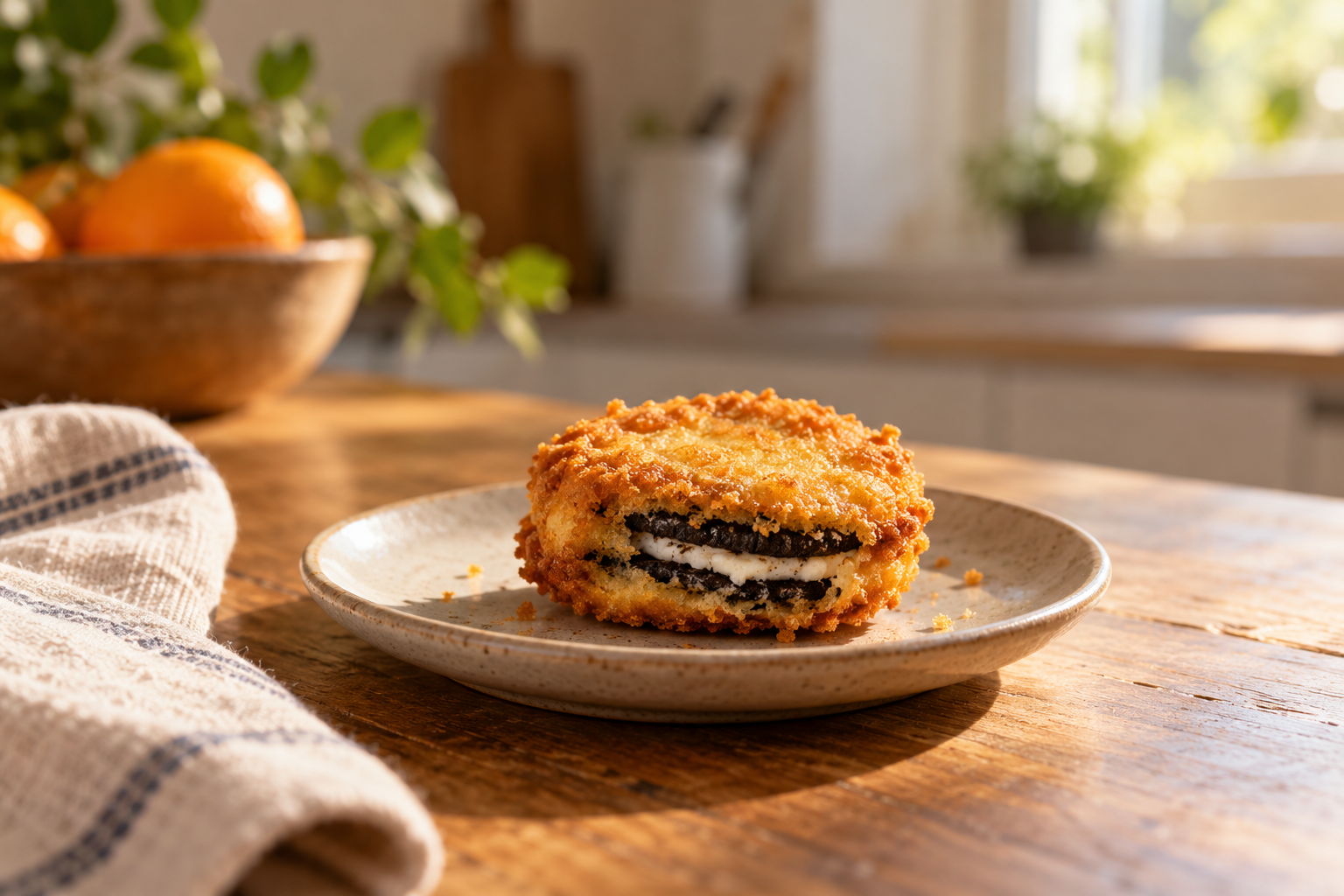
If I could go back in time with a billion fried Oreos and carefully distribute them, would I save more lives or kill more people?
I asked a group of medical students that question recently. Their first instinct was that I would kill more people. After all, fried Oreos are not exactly what comes to mind when we picture healthy food.
But then I added a condition: What if I didn’t give people unlimited access? What if I gave someone just one fried Oreo a day?
My thought was that, in a population facing starvation, those extra calories might save lives. In that setting, a fried Oreo could be considered a remarkably useful food: You can fit it in a little pouch, and it has a lot of energy.
That doesn’t make it a great foundation for a diet today. It does illustrate something I think we often miss when we talk about healthy habits: The environment matters.
Why do we struggle to make healthy choices?
Human beings have strong instincts to seek pleasure, conserve energy, and avoid pain. Those instincts are not inherently bad. They help us survive.
But we now live in an environment that can be very different from the one in which many of those instincts developed. For many of us, calorie-dense foods are readily available. Screens and other sources of immediate stimulation are almost always within reach. We can often get through a day without moving our bodies very much.
That doesn’t mean the environment is the same for everyone. People face different constraints on their time, money, access to food, opportunities for exercise, and capacity to make changes. Those differences matter.
It does mean that when we struggle to choose a long-term benefit over an immediate pleasure, we are facing a challenge worth understanding—not just a personal failure to condemn.
What about “tomorrow you”?
There’s a joke in Seinfeld about a problem belonging to “tomorrow Jerry.” Homer Simpson makes a similar joke about leaving a problem for “future Homer.”
It’s funny because it feels familiar. The person who will benefit from going to bed earlier, exercising, or changing a habit can feel strangely distant from the person deciding what to do right now.
We have some capacity to act for that future person. We save money. We make appointments. We do difficult things today because we hope they will make tomorrow better.
But immediate rewards are vivid. Future benefits can feel abstract. A comfortable chair is here now; the benefit of a walk may be harder to see. That doesn’t mean the walk has no immediate value, or that every choice should be made for the sake of some future outcome. It means that a plan for healthier behavior has to account for the person making the choice today.
How can you make a healthy habit easier to maintain?
If you want to change a behavior, it may help to ask a different question.
Instead of only asking, “Why don’t I have more willpower?” ask:
- What makes this behavior hard for me right now?
- What would make it easier?
- Is there a smaller version I could do consistently?
- What matters to me enough that I want to make room for it?
For example, if you want to move more, the first step might not be an ambitious exercise program. It could be placing your walking shoes by the door, asking someone to walk with you, or finding ten minutes in the day when a walk feels realistic.
The point is not to pretend that every obstacle has a simple solution. Some obstacles are substantial. The point is to look carefully at the circumstances around a behavior and see what can be changed.
Start with what you value
At the end of our discussion, I asked the students to make a list of five core values. I also asked them to think about what that assignment might have to do with our conversation about health.
For me, that is an essential question. Health is not just a collection of numbers, and healthy behavior is not an end in itself. We can ask what we want our health to make possible: time with people we love, the ability to serve, the freedom to explore, or the energy to participate more fully in life.
Knowing what matters doesn’t automatically make change easy. But it can give us a reason to look at our habits—and our environment—with curiosity.
The goal is not to stop being human. It is to understand ourselves well enough to build a life that helps us do more of what matters.